0
While the poem may seem intended for children, its meaning goes far beyond a simple nursery rhyme.
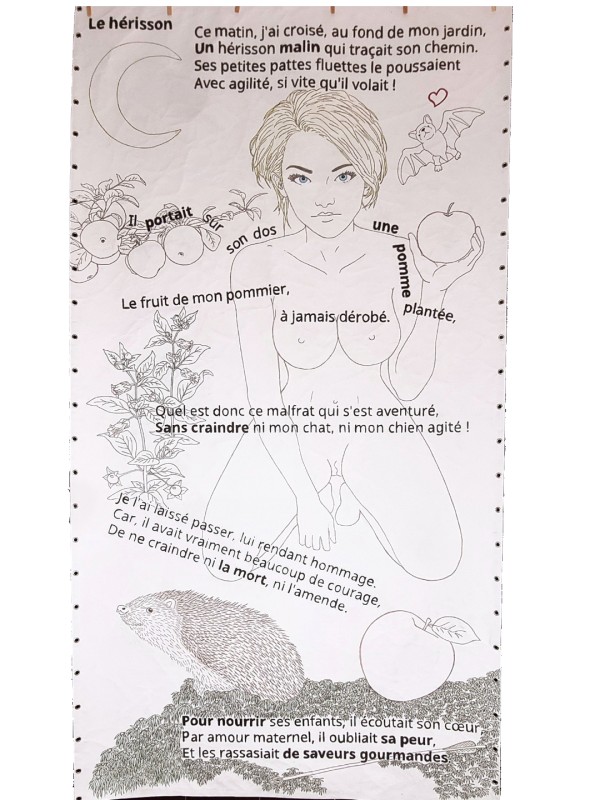
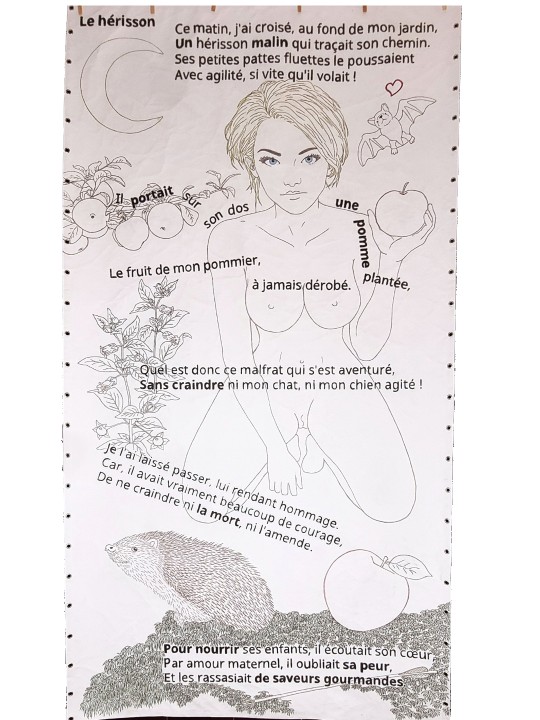
The first reading recounts a story involving the goddess Diana (whose presence is indicated by the crescent moon) and a hedgehog. In this tale, the animal is an excellent parent, ready to risk its life to feed its young. But it is also a wild animal under the goddess's protection. Therefore, it is only natural that she watches over it.
The second reading (in bold) is quite different. The apple evokes three sins: theft, gluttony, and lust. The cunning one insults the goddess in an almost suicidal act. But who is this cunning one?
The pictorial representation then enriches the narrative. The hedgehog is no longer carrying the apple; it rests behind him. He is therefore not the one at fault in the story. Like Diana, he observes the viewer, the reader of the poem. The reader is thus, in effect, implicated in the story. The hunting arrow placed on the moss, beneath the "gourmet flavors," is a clear warning to the reader: By remaining in front of the canvas, they risk becoming prey, a hunting toy for the deity. A gourmet flavor.
The apple tree also evokes the legend of the apple of discord. But that is another myth.
The moss symbolizes the coolness of the undergrowth. As for belladonna, a poisonous plant whose effects distort vision by creating a sensation of accelerated movement, its presence explains the hedgehog's agile movements in the poem. But it also symbolizes the mortal danger into which the reader of the work has entered.
-
Painting on canvas. Dimensions may vary by a few millimeters.
Pigments applied with mineral or vegetable binders.
Graphite.
Acrylic paint & India ink.
-
Each unique artwork has its own identification number in the artist's official catalog.
Catalogue No. 006
-
The sale of the canvases will begin in 2027.